
Six months ago, I wrote about spending thousands of dollars and countless hours on things that almost worked. The AI Parliament project taught me about context windows, the difference between chatbots and agents, and why I needed to be a product owner, not just a prompter.

I ended that piece teasing updates to my Crypto Grant Wire with a: “(if I can get it working).”
I got it working.
Not just that one but a few projects shipped since June, and maybe a couple dozen things I hacked together, hated or didn’t work, and scrapped. But I learned from all of them and am now quickly iterating on new ideas and builds using Claude Code and Ralph Wiggum (more on this in a future post maybe?)
This is the story of moving from almost to actually, and what it took to get there.
Quick Recap
For those who didn’t read the original (or forgot, which is fine), here’s the short version: I’m an operator who always regretted not learning to code. When AI tools got good enough that I could finally attempt building things, I went all in on a project called the AI Parliament. It was supposed to be a system of specialized agents that could scan governance forums, analyze proposals, and present insights.
I did get it “working” eventually, but found there’s so much more to develop before I’d release anything. I have some ideas on adapting the concept to another use case I care about. Maybe I’ll share that here someday when it’s ready.
But that project taught me something: you can’t just throw prompts and hope for magic. You need architecture. You need a plan. You need to act like a product owner.
I took that lesson and started smaller.
Sov’s GG24 Summarizer
Back when I was still at Gitcoin, we were in the middle of GG24 sensemaking on incoming proposals. This was summer 2025, right around when Claude Sonnet 4 had just dropped. There were a lot of proposals to review, and I thought: what if I built something where anyone could look at the proposals and get AI analysis?
This was before I started using Claude Code. Just me, Claude in a browser, and a lot of copying and pasting between the chat and a couple of IDEs.
What I built: A two-panel site - Sov’s GG24 Summarizer. One side shows the proposal, the other lets you run it through Claude or ChatGPT for summarization and analysis. Looking back, it’s rough. But at the time I was thrilled to have something live on the internet that I built.
What I learned: How GitHub works. Pushing code, managing branches, understanding what a commit does. Table stakes for any developer, but I’d never done it myself. Then connecting GitHub to Railway so updates deploy automatically. My proof to myself that I can get something from idea to working website.

Multi-Channel AI Assistant
I get a lot of newsletters via email. Substack, governance updates, market intel. What I wanted was a bot I could email things to, have it summarize whatever I sent, and respond in Telegram. Then continue the conversation there, with the bot remembering what we’d discussed.
This sent me down a rabbit hole. I learned the difference between local models (still not really using them), vector databases and RAG (understand the concept, haven’t implemented it), and basic databases (actually got this working).
What I built: A Telegram bot backed by a Postgres database in Railway, using the Claude API. When I send it a message, it logs the exchange and builds context over time. I can email an address using CloudMailin, and the bot summarizes whatever I sent and responds in Telegram.
What I learned: How to build a Telegram bot from scratch. How to set up and manage a simple database and build in email workflows.
ENS Public Goods Dashboard
I’m a steward for ENS Public Goods, and we were putting together our Term 6 retrospective. I started wondering if I could use AI to research everything we’d published over the year and pull insights from it.
I’ve been using Manus for a long time and know its features well. I actually canceled my subscription at one point, but their recent 1.5 and 1.6 updates made the product much better. I came back and now use it quite a bit in different ways.
For this project, I fed it all our forum entries and publications. It consolidated everything and generated insights I could share with Simona for accuracy checks. Then I realized I could take that same research and turn it into a dashboard.
Manus creates projects you can export to GitHub. So I connected the output to GitHub, then used Claude Code to iterate. Push improvements, deploy to Railway, see the results, repeat.
What I built: The Term 6 Dashboard shows strategic grants, builder grants, and interactive visualizations of the whole term.
What I learned: Manus is great for research, not just building. You can chain tools together: Manus for initial research and build, GitHub for version control, Claude Code for iteration, Railway for deployment. And building something useful for teammates is way more motivating than building for yourself.
Crypto Grant Wire Rebuild
This is the one I’m most proud of.
The Crypto Grant Wire is a Telegram channel I’ve been running for years. Over 4,000 followers. For crypto grants nerds like me, it’s where you track updates across the ecosystem.
Sov's Crypto Grant Wire Telegram
For a long time it was just a Notion database. I’d add links manually, Make (formerly Integromat) pushed them to Telegram, and that was it. Then X23 started feeding in automated entries from governance forums, which added value but also created data format inconsistencies.
What I always wanted: take the entire history of the grant wire, put it in a structured database, and summarize every entry consistently. The problem was years of manual entries plus X23’s different format meant the data was a mess.
What I built:
First, a tool called TeleSum that pulls all messages from a Telegram channel and summarizes them. I used Grok 4.1 for the summarization because most of the links are from Twitter, and Grok can actually read Twitter content. Most other AIs can’t.
Then came the tedious part. Tuning the summarization. Handling edge cases. The X23 entries had source links pointing to a domain that no longer exists, so I had to reverse engineer those back to the original governance forum URLs.
The pattern was actually straightforward once I (or Manus rather) figured it out. x23 URLs had a predictable structure that mirrored the original Discourse forums. The slug at the end of the x23 URL was the same slug used in the original forum. So I extracted the protocol name from the x23 URL (like “makerdao”), looked up the known governance forum domain for that protocol, grabbed the slug, and combined them. For Snapshot votes, the x23 URL contained the proposal hash, so I constructed those URLs too. Pattern matching and a lookup table.
Now TeleSum runs automatically. New entries come in, database stays current. I’m building out APIs and export functions for anyone who wants access.
On the frontend, I built a web interface that aggregates the Notion data, adds the Telesum database as a searchable archive, and gives everything a proper home.
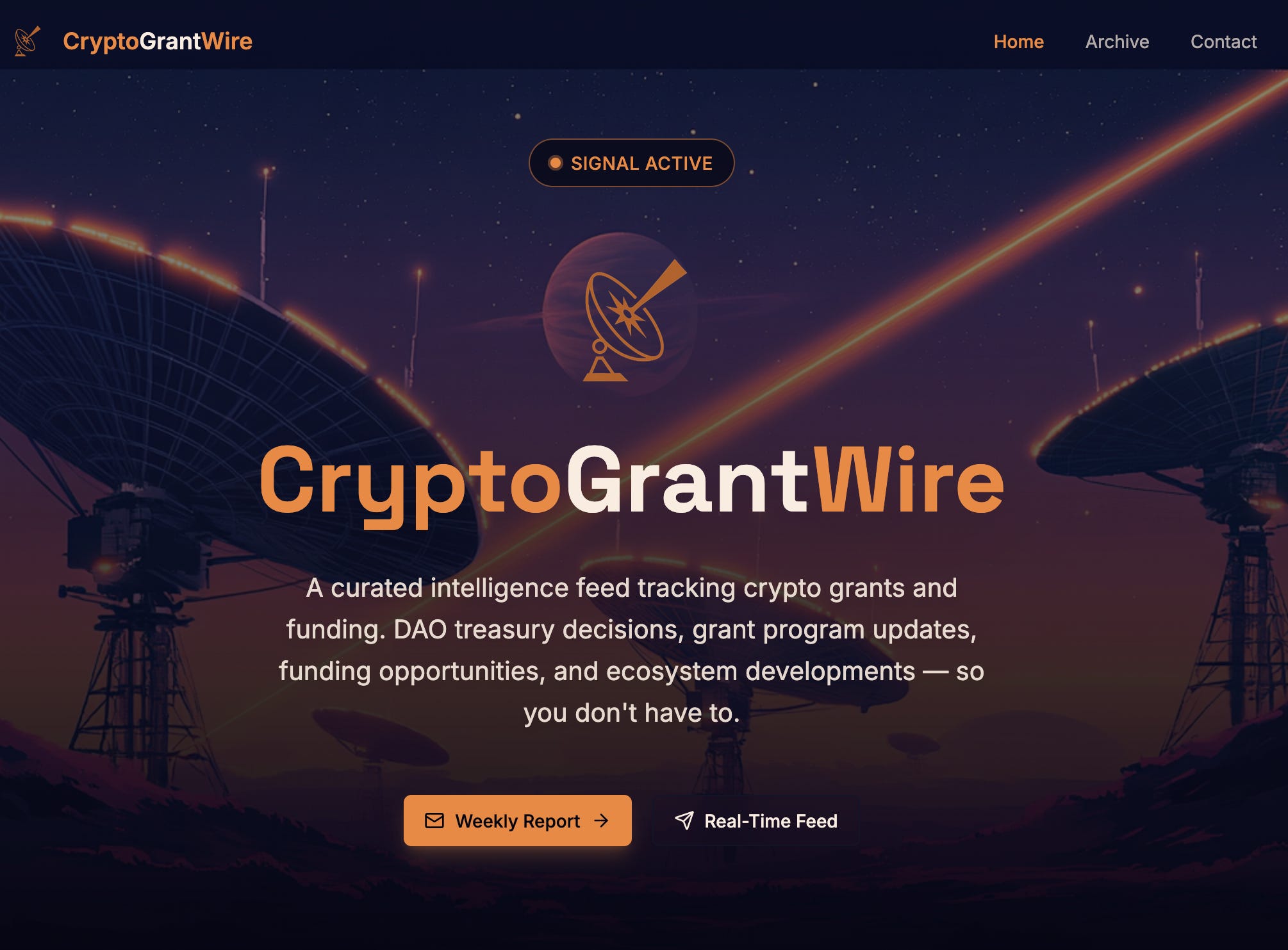
It’s still amateurish looking. I know. But it works, and it’s the foundation for everything else I want to build for the grant wire. You can check it out at the link below if you like!
https://crypto-grant-wire-site-v1-production.up.railway.app/
What I learned: Different AI models are good at different things. Grok for summarizing Twitter posts. Claude for coding. Gemini for fast iteration on specs. Years of manual work can become structured data if you’re patient. And building for your community beats building for yourself.
What Changed
The tools haven’t changed much since June. Claude, ChatGPT, Cursor, Windsurf, Manus, Railway. Same cast of characters.
What changed is my approach.
Six months ago I was throwing vague prompts at tools and hoping for magic. Now I start with architecture. Break tasks into small, testable chunks. One thing at a time. Commit working code before moving on.
I still hit walls. The AI assistant took way more iteration than expected. The Grant Wire data cleanup was tedious. Every project has a moment where you wonder if it’s ever going to work.
I don’t think of myself as someone who can’t build things anymore. I’m someone who builds things slowly, with a lot of AI help and a lot of trial and error. That’s enough.
For Other Operators
If you read the original piece and thought “I should try this,” the answer is still: just start. But start with something small and specific. Something you actually want to exist. The motivation matters when you’re debugging at midnight.
The gap between almost and actually is persistence. Dedicate the time. Make sure everything you do moves toward progress. The tools are good enough now that if you stick with it, things will work.
The juice is still worth the squeeze. More than ever.
Peace,
Sov